Variations on the Same Theme
After twenty-five years of existence and many very different installments, one may wonder what constitutes the essence of Zelda. Is it a story with a little green man who isn’t even allowed to be named in the title? Is it a particular form of dungeons and gameplay? Is it a series of sounds that return in every episode? What is it that makes us ultimately replay the same game and enjoy it?
The first documents relating to the video game The Legend of Zelda date from 1985. At the time, there was simply the word “Adventure” on the folder gathering the few sheets detailing the game. Among them were the progression through the adventure and the dungeons, the number of dungeons, the items, and the enemies.
Zelda is directly linked to Mario, which was also an “adventure.” Gameplay elements not used in the plumber’s title were often reused in the action-adventure game. The creators of these two games were nicknamed “the Golden Triangle”: Shigeru Miyamoto, Takashi Tezuka, and Toshihiko Nakago.
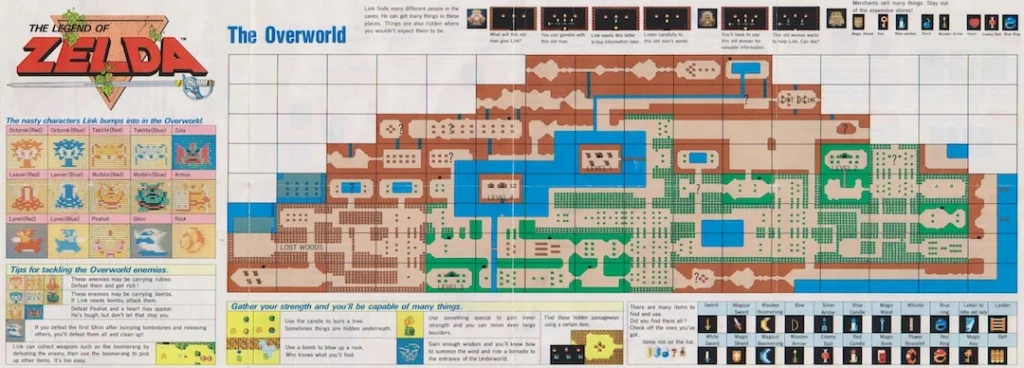
They developed Zelda while working on Super Mario Bros. And as with Mario, the documents show that from the outset there was a global vision of the game, giving it coherence, and a direction that did not change along the way.
Dungeons Without Dragons
Miyamoto never bothers with a story, because what interests him above all is gameplay and the pleasure derived from the video game itself. That is why the kidnapping of Princess Peach in Mario or of Zelda in the eponymous series is a mere pretext for adventure.
The RPG side of the first Zelda is negligible, and apart from the archetypal roles (hero with a sword, dungeon, princess) and the setting, ultimately little distinguishes Mario from Zelda. There is so little difference that in Link’s Awakening, when the character is in an underground passage, Link appears in profile view in platforming sections similar to those found in Mario.
In the first Zelda, when Link has full energy, he can thrust his sword forward to kill enemies, somewhat like Mario throwing fireballs when he temporarily acquires that bonus. You are thrown abruptly into the game and must fend for yourself in a vast world full of enemies, going from cave to cave and killing other enemies… At the limit, the surface world is merely a vast corridor connecting the dungeons, the places where the adventure truly unfolds.
At the time, memory space had to be truly economized, and the team made sure that all the rooms of all the dungeons fit into a single rectangle, with the shapes of the dungeons fitting together like puzzle pieces.
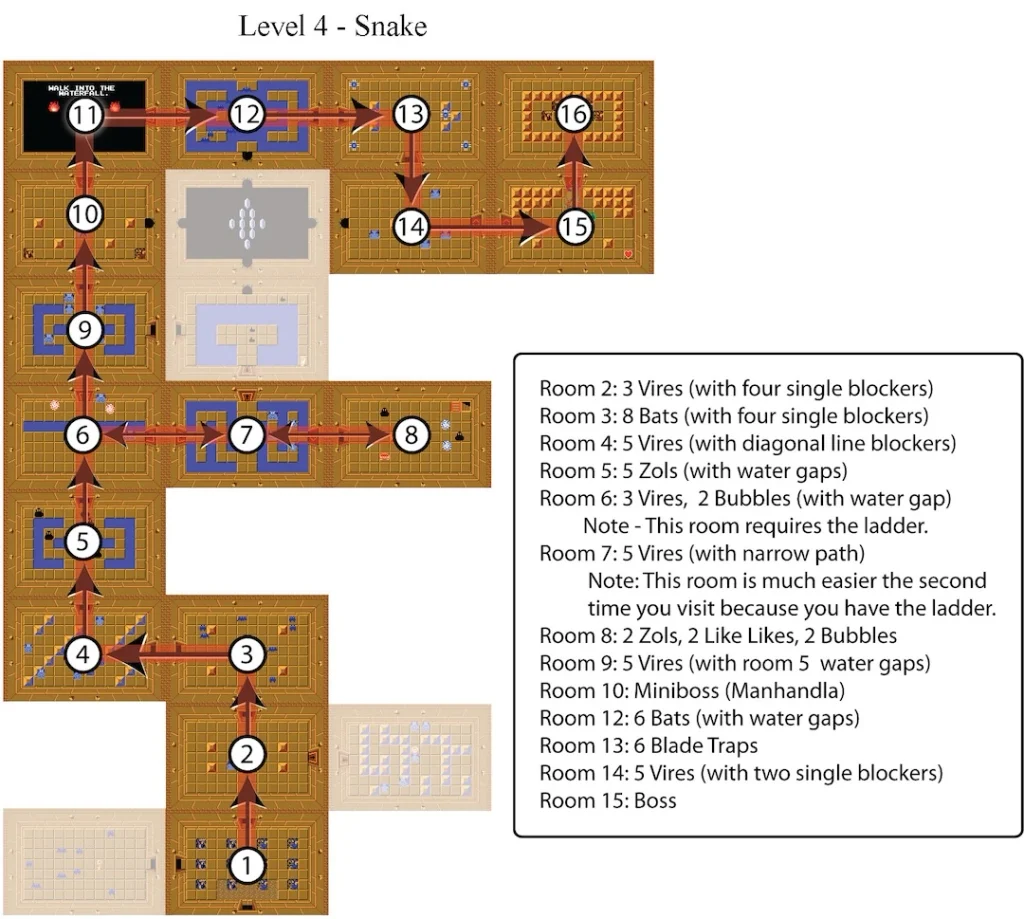
Following an error, since in the end everything fit in less space than expected, the remaining space was devoted to creating a second quest (to be played once the game was finished) with other dungeons and other puzzle shapes. That shows just how much these places are at the heart of the first Zelda.
In the draft of Ocarina of Time, the game almost became a single, unique dungeon: Ganondorf’s. In the manner of Princess Peach’s castle in Mario 64, it would have been possible to move from one room to another and from one universe to another. Link would then never have left the dungeon. Fortunately, the final game is quite different, and exploration plays a significant part in the pleasure associated with this title.
In Majora’s Mask, the entire world became a dungeon that you continually replay until you manage to solve all the puzzles and prevent the moon from crashing down. In an interview, Aonuma specifies: the game is
“like a big dungeon in itself, probably the biggest ever designed for the Zelda series, and it was very difficult to design and balance the progression.”
As for the three cel-shaded Zeldas, they place the dungeon at the center of the imaginary world and the gameplay, since you are invited to go there regularly to progress floor by floor up to the final battle.
Staging the Learning Process
Beyond the omnipresence of these dungeons, each location offers the same type of progression with three recurring items: map, compass, and keys. The player explores the rooms and navigates using the map so as not to miss any rooms. The compass essentially serves to find the boss room, and the keys add a constraint that requires going through the same places several times (something very important in the early episodes to save memory and extend playtime).
Another recurring element: each dungeon offers a new weapon halfway through. The second half of the dungeon allows the player to learn how to use it so as to employ it optimally in the final fight against the boss. It is somewhat as if each dungeon were a new place of playful learning, a giant tutorial for an item that the player masters by the end of the level and can then combine with the other items collected in subsequent dungeons.
As Eiji Aonuma explains, the dungeon can also be considered as a play or a narrative in itself, with its initial situation, a major twist halfway through with the new weapon allowing access to places previously impossible to reach, and a final battle. Learning to handle the new weapon is thus inscribed both in the exploration of space and in a proto-story. From there to saying that the dungeon theatricalizes gameplay…
But those are very grand words that struggle to describe the pleasure of having a new weapon and discovering all the opportunities it offers. It is this particular joy that drives the player forward to find the next dungeon.
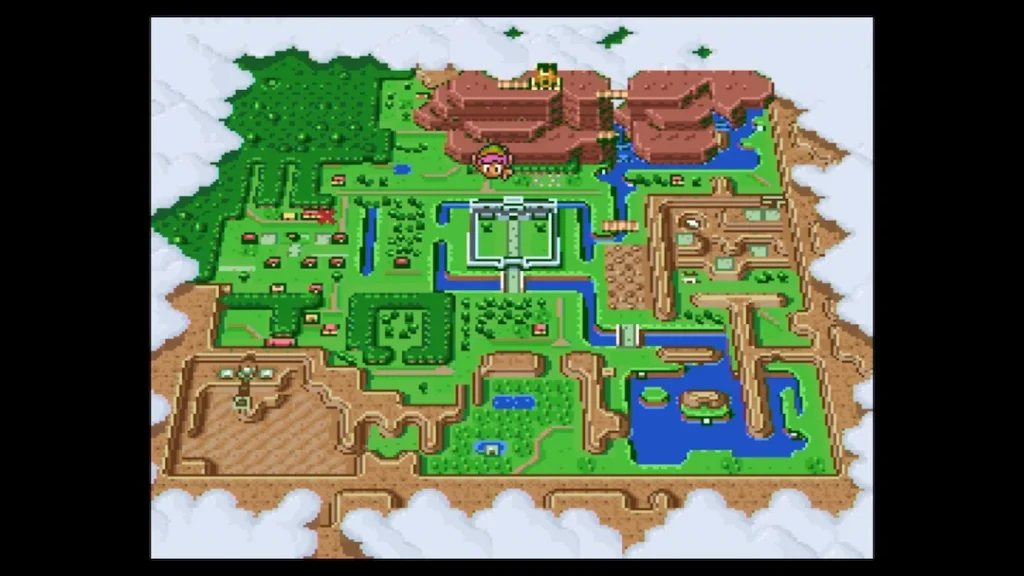
Ultimately, the video game Portal 2 merely gives an FPS and HD veneer to a concept initiated by A Link to the Past in 1991: a succession of rooms in a dungeon/a laboratory, progressive learning, and the joy of solving puzzles.
A Good (Chinese) Villain!
Apart from Link and Zelda, the recurring character of the saga is Ganondorf, an emblematic villain who can take many forms. If some lament always finding the same trio, for Aonuma and the Japanese developers, this group of characters constitutes an essential element of the Zeldas. He says on this subject:
“For me, it’s a little theater in which I tell new stories, I put in new set elements to surprise the audience.”
This recalls in many respects the commedia dell’arte, an Italian theater based on improvisation around archetypal characters who are found in other theatrical forms: Harlequin, Pierrot, and Columbine.
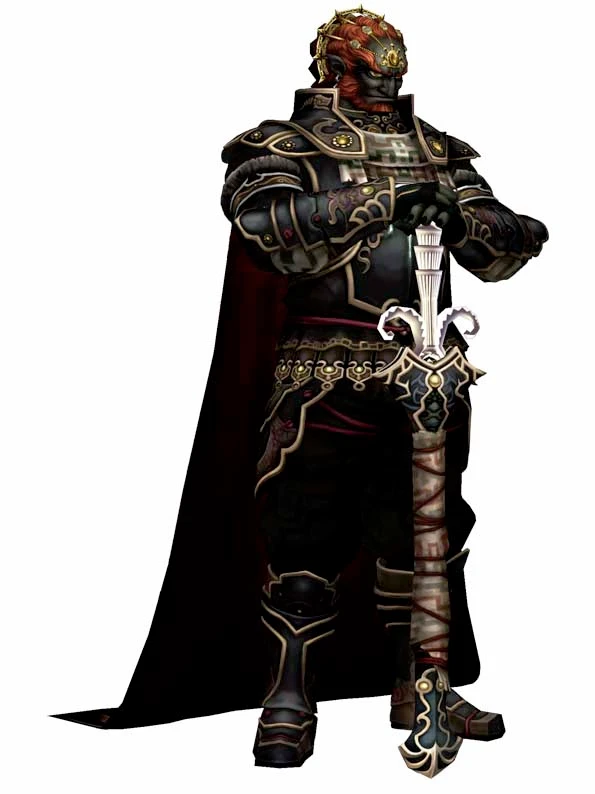
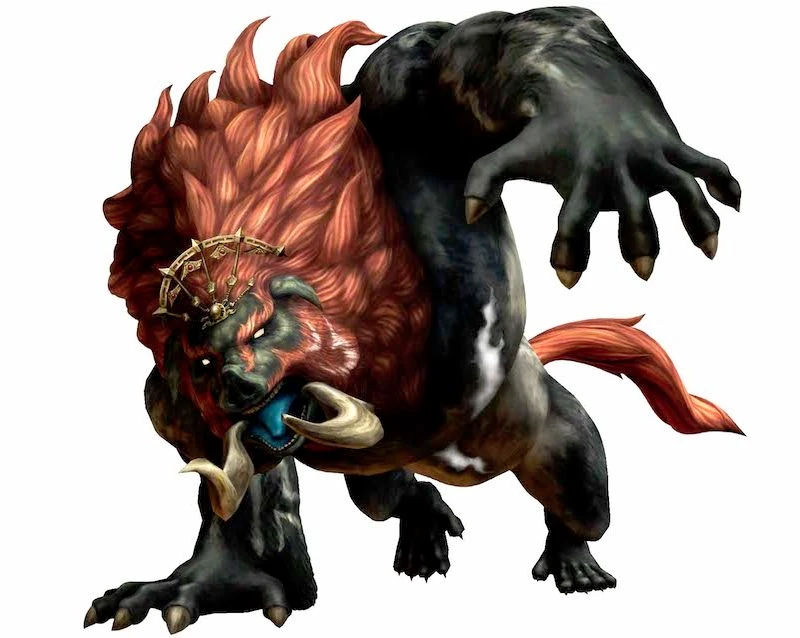
One could almost go so far as to compare the Zelda-Link-Ganondorf trio to the mythical figures that form Greek tragedies. Let us recall that the Greeks base almost all their theater on two cursed families (the Atreids and the Labdacids) whose exploits are played and replayed in different plays featuring the same characters and the same actions. Only the dialogues and the structure of the plays change.
Surprisingly, this seemingly Western trio includes a figure well known from Asian folklore. The first documents from 1985 contain a list of enemies, including the absolute villain who returns in every episode: Ganon. At the time, he was named Hakkai in reference to Cho Hakkai, the porcine general who accompanies the Monkey King in the Chinese legend of the same name (see IG 11, p. 186-189, Multiverse — The Monkey King).
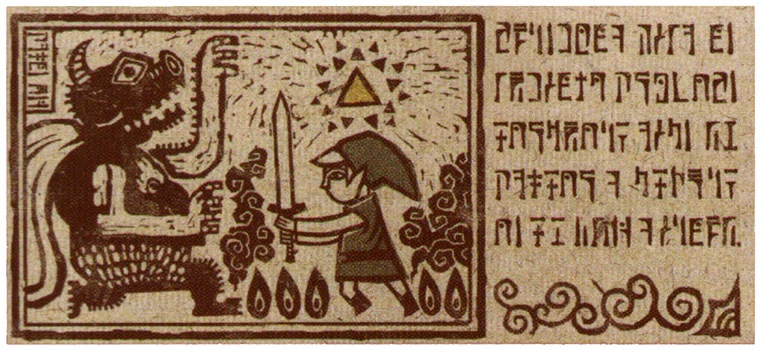
In the novel from which these folkloric characters come, Hakkai bears the Chinese name Zhu Bajie or Pakai (豬八戒 or 豬悟能). He is a fallen heavenly general whose pig form bears witness to his disgrace. He is capable of thirty-six different metamorphoses and loves good food. But he loves women even more.
His various characteristics are found in Zelda’s “villain”: he always kidnaps the princess and possesses several appearances, and even several names, since Ganon corresponds to the animal form while Ganondorf would be his name when he has a more human aspect. Moreover, in several Zeldas, he uses a trident, a traditional weapon in legends, which was doubtless chosen because the kind of rake that the porcine general regularly brandishes in images related to the Chinese novel was more difficult to fit into a universe tinged with heroic fantasy.
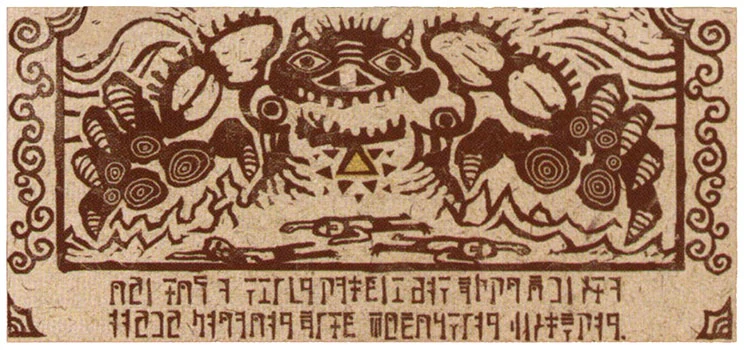
It is doubtless because of this reference that the character has boar-like features in several episodes. Apart from this nod, there does not seem to be any other link between the video game and the Chinese tale. But it is quite funny to see that in a game taking up the codes of the Western RPG, the emblematic villain is linked to Asian folklore.
A Narrative in the Service of Gameplay
Gameplay, and more particularly the dungeons, are therefore the essence of Zelda. That is why the gallery of characters matters little at the beginning of the saga, and why it is used as archetypal figures similar to those of theater. This rule applies from the very conception of the games. The characters and the plot are created afterward in relation to game design constraints. It was because they needed a cursor to help the player find their way in the 3D environment that the fairy Navi was created in Ocarina of Time.
Likewise, the character of Midna in the video game Twilight Princess was created solely because Miyamoto found it boring for the player to have nothing but a wolf’s back to stare at during a large part of the game. They first placed a form riding on Link in his canine form before making it a talking character interacting with the world.
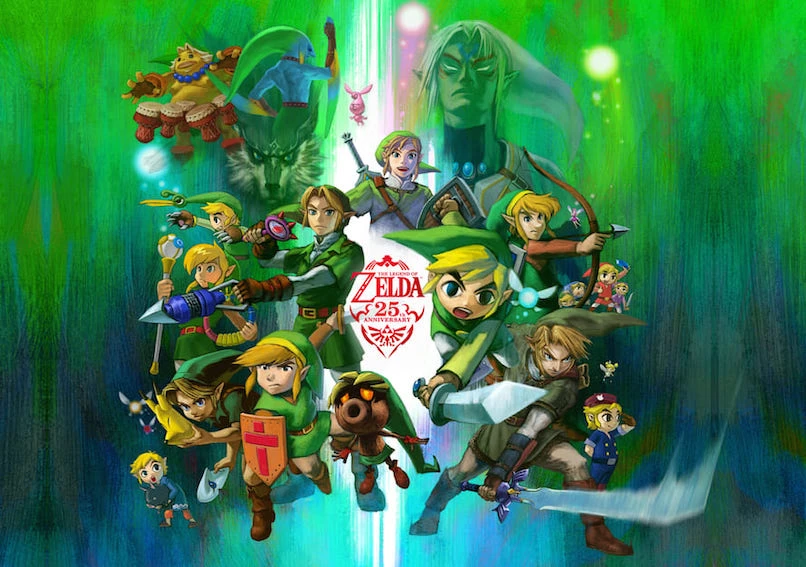
Similarly, it was because they needed a second character to have cooperative gameplay that they took Zelda and built the story to justify the fact that she is a ghost in Spirit Tracks.
In Ocarina of Time, it was because Miyamoto absolutely wanted Link to appear in the form of a child, even though the design of adult Link had already been made, that the teams developed two Links and found a plot allowing both versions to be played. The story always comes afterward to justify the game design choices.
And yet, over the course of the episodes, a mythology is built, and the narratives are increasingly successful.
Thus Zelda, who gives her name to the game, is at first only a vague pretext. Marin, from Link’s Awakening, has more personality than her and plays a more important and moving role. After this pivotal episode, the plots of the Zeldas become fuller and take on a more epic character or, in any case, manage to stir more emotion.
Princess Zelda becomes more autonomous in Ocarina. In the guise of Sheik, she helps you when you are an adult. In The Wind Waker, she is the tomboy Tetra. Is that why her name evokes the square and no longer only the triangle of the Triforce?
In Spirit Tracks, she has a well-defined personality, and in Twilight, Midna is a character who evolves between the beginning and the end of the story. Even if the narrative is not at the heart of the game, talented authors nevertheless manage to write credible stories and endearing characters. And over the years, that too is part of what makes a good Zelda. The little theater thus offers better dialogue and a more developed plot.
A Narrative in Action
In the majority of Western RPGs, the player begins by creating their character, defining their characteristics and appearance. In the video game as Miyamoto imagines it, there is nothing of the sort, because you go straight into the action and the character is created through interactions with non-player characters (NPCs).
Since the hero is not created by the player, the player discovers him through actions and by embodying him in the world of Hyrule. It is also because of this major inversion that storytelling in Zelda does not resemble that of other titles.
Miyamoto hardly likes cutscenes that interrupt the game and do not integrate with the gameplay. In any case, technically, it would have been difficult to include them in the early installments of the saga.
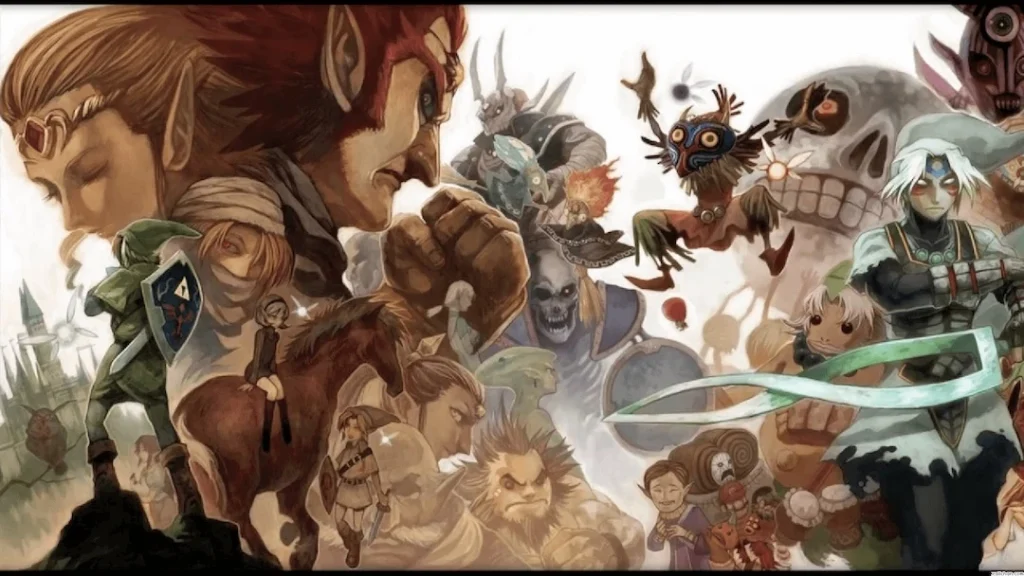
But over time, he eventually came around to Tezuka’s ideas, and secondary characters take on more importance in defining the hero’s place by contrast. Taking up Tezuka’s ideas, Miyamoto explains in an interview that he was also influenced by the series Twin Peaks (broadcast in Japan in 1991):
“I understood that telling a story interested me less than seeing many characters evolve around the main character and depicting their relationships. A few years ago, the series Twin Peaks was very popular. I watched it and found that the most interesting thing did not lie in the ins and outs of the story, but in the types of characters featured in it. […] I think these strange and unusual characters are interesting in themselves. I am more interested in their presence than in their personal story, in knowing who is whose cousin or whose parents and why they are sworn enemies, or when and where they come from. […] What is important is the role they play and how they contribute to depicting the main character.”
That is why you discover the narrative by playing, you understand the world of Hyrule and its mythology by talking with the characters, and the hero you embody takes shape by contrast with the words of others and with his own actions. And since Link does not speak, the place of dialogue and secondary characters grows in order to create, somewhat despite Miyamoto, an epic narrative.
One can therefore only salute the talent of Toru Osawa for the narrative of Ocarina of Time and all the subsequent scriptwriters for having been able to bring to life this world designed above all to be functional and in the service of the player character. It is therefore a way of creating and telling a story very different from what can be done elsewhere, but this form of storytelling also constitutes the essence of Zelda.
The Pleasure of Reunion
The last element, and not the least, that makes a good Zelda video game lies in the recollection of past episodes. Anyone who has played a Zelda knows that the villain is Ganondorf, that the pieces of the Triforce must be gathered, etc. They know it; there is no surprise at that level. They might even grumble and say that it is broadly the same game over and over again. But this variation on the same theme creates a particular pleasure characteristic of a good Zelda.
Let us take examples from outside video games. What fans of Sherlock Holmes appreciate is not so much the resolution of the cases but finding the same quirks in the character over the course of the stories.
What we like in the series House is not the curing of the patients but the doctor’s quips and his little habits. Umberto Eco theorized this specific pleasure by taking the case of serialized novels and modern TV series.
The serialized novel, founded on the triumph of information, represented the favorite food of a society living amid messages laden with redundancy […] In our contemporary industrial society, on the other hand, the alternation of parameters, the loss of traditions, social mobility, the wearing down of models and principles—everything is inscribed under the sign of an incessant charge of information advancing in brutal jolts, constantly implying readjustments of sensibility, adaptations of psychology, requalifications of intelligence. The narrativity of redundancy thus appears here as a gentle invitation to rest, the only occasion for real relaxation offered to the consumer.
Umberto Eco, De Superman au Surhomme, Paris, Le Livre de poche, 2005, p. 137
In the Zelda video games, we find this “narrativity of redundancy,” this particular pleasure of finding oneself on familiar ground while being surprised. It is somewhat the same thing in the Final Fantasy series, where Moogles necessarily appear, a character named Cid, etc.
The world of Zelda may doubtless seem a little curious compared to the standards of the Western RPG. Isn’t it a little too naive with its twelve-year-old kid who saves the princess from the villain every time?
But what makes its essence is doubtless also what makes it a good video game: the preponderance of gameplay.
Leave a Reply